
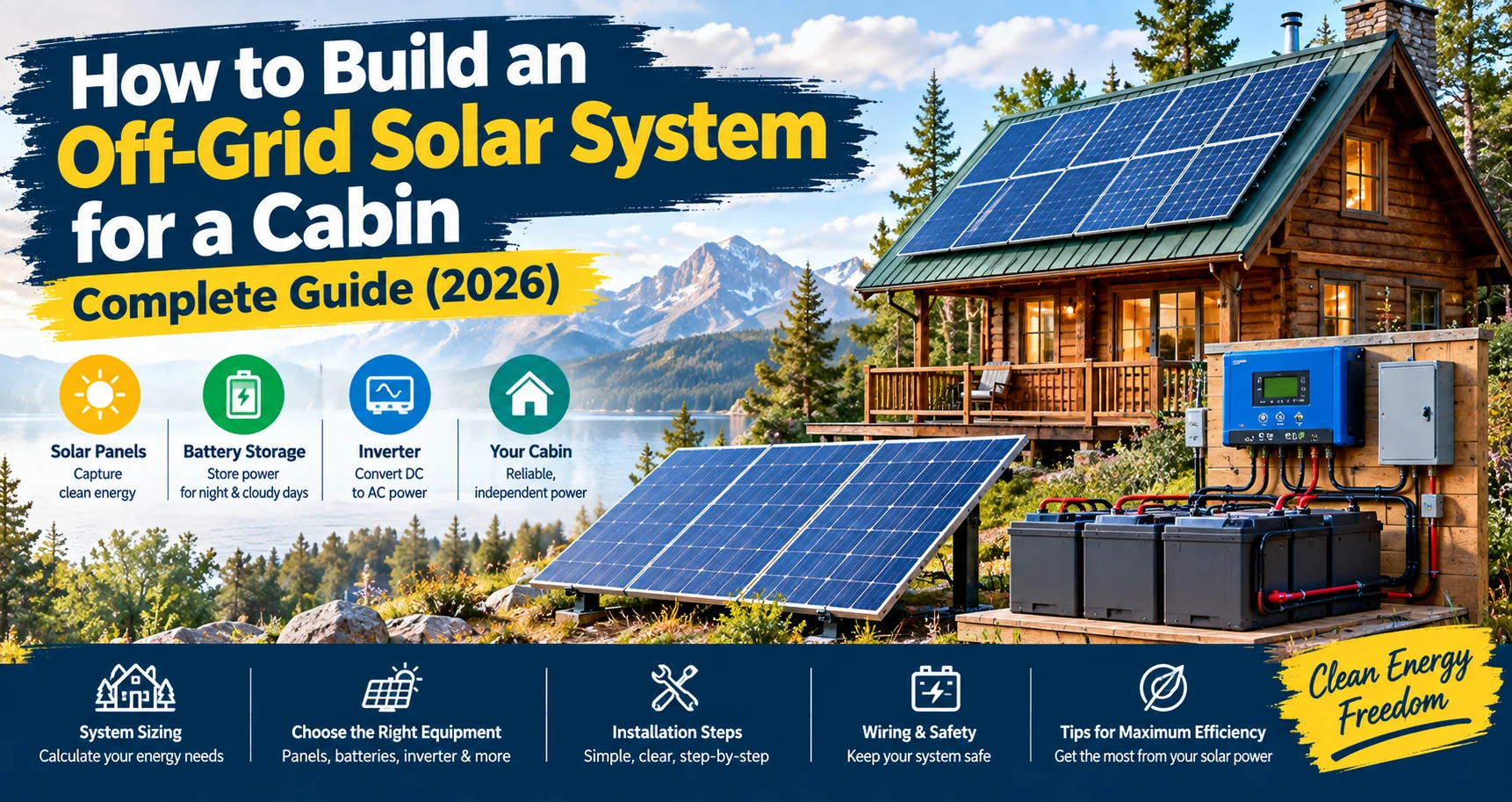
OFF-GRID LIVING GUIDE · 2026
How to Build an Off-Grid Solar System for a Cabin: Complete Guide
Learn how to design a reliable cabin solar power system with solar panels, battery storage, a charge controller, and an inverter to power your essential appliances without relying on the utility grid.
Imagine spending time in a remote woodland cabin without worrying about power outages, expensive utility connections, or the limitations of traditional electricity sources. With the right off-grid solar system for a cabin, you can generate electricity from sunlight and store enough energy to power essential appliances throughout the day and night.
Whether you are building a weekend retreat, a hunting cabin, a tiny home, or a full-time off-grid residence, solar energy can provide a practical source of electricity when the system is designed around your actual energy needs.
However, an effective off-grid system requires more than installing a few solar panels. You must calculate daily energy consumption, choose the correct battery capacity, size the inverter, and ensure that all electrical components work together safely.
To build an off-grid solar system for a cabin, calculate your daily electricity consumption, estimate the solar energy available during the least sunny season, size your solar array and battery bank, and select compatible charge-control and inverter equipment. Include suitable electrical protection, safe wiring, and a backup power plan for extended cloudy weather.
1. What Is an Off-Grid Solar System?
An off-grid solar system generates electricity without depending on a public utility connection. Solar panels capture sunlight and produce direct current (DC) electricity, which a charge controller manages to charge the battery bank.
The battery stores energy for nighttime use and periods when solar production is low. An inverter converts DC electricity into alternating current (AC) for compatible household appliances.
Unlike a conventional grid-connected solar installation, an off-grid system must be designed to meet its own energy requirements. There is no automatic guarantee that utility electricity will be available when the batteries run low.
Energy Independence
Generate electricity in locations without a convenient utility connection.
Stored Electricity
Use energy saved in batteries when sunlight is unavailable.
Flexible Design
Scale your equipment according to your appliances and available budget.
For a small cabin, a basic installation may power lights, communication devices, and a few small appliances. A larger system can support refrigeration, water pumps, office equipment, and other household loads when correctly designed.
2. Essential Components of a Cabin Solar System
A complete off-grid solar system contains several interconnected components. Each one performs a different function, and the system’s reliability depends on choosing compatible equipment.
Solar Panels
Solar panels convert sunlight into DC electricity. The total panel capacity, measured in watts (W), determines how much power the array can produce under specified test conditions. Actual production varies with sunlight, shading, temperature, orientation, and other factors.
Solar Charge Controller
A charge controller regulates the electricity supplied by the panels to the battery. A suitable maximum power point tracking (MPPT) controller can efficiently convert solar array voltage into the charging voltage required by the battery bank.
Battery Bank
The battery bank stores electricity for use when the panels are not producing enough power. Lithium iron phosphate (LiFePO4) batteries are popular in many modern off-grid installations, while other battery chemistries may suit different budgets and operating conditions.
Solar Inverter
The inverter converts battery DC power into AC electricity for household appliances. Its continuous power rating and surge capacity must accommodate the appliances you expect to operate simultaneously.
Electrical Distribution and Protection
Appropriately rated conductors, fuses, circuit breakers, disconnects, grounding and bonding equipment, and distribution panels help protect the installation. Their selection depends on the system design, equipment instructions, and applicable electrical codes.
How the System Works
Solar Panels → Charge Controller → Battery Bank → Inverter → AC Appliances
A separate protected DC distribution circuit can supply compatible DC appliances directly from the battery system. Both AC and DC circuits require correctly selected protection and wiring.
3. Calculate Your Cabin’s Energy Needs
Before purchasing solar equipment, determine how much electricity your cabin uses each day. This is the most important step because the size of the solar array and battery bank depends on your energy consumption.
For each appliance, multiply its power rating by the number of hours it operates daily.
Daily Energy (Wh) = Power (W) × Hours Used
Divide watt-hours by 1,000 to convert the result into kilowatt-hours (kWh).
Example: Daily Electricity Consumption
| Appliance | Power | Daily Use | Energy |
|---|---|---|---|
| LED lights | 60 W | 5 hours | 300 Wh |
| Laptop and charging | 60 W | 4 hours | 240 Wh |
| Refrigerator | 150 W average while running | 8 equivalent hours | 1,200 Wh |
| Water pump | 300 W | 1 hour | 300 Wh |
| Fan | 50 W | 8 hours | 400 Wh |
| Phone charging and miscellaneous devices | 60 W combined | 3 hours | 180 Wh |
| Estimated Daily Total | 2,620 Wh | ||
This example uses approximately 2.62 kWh per day. It is illustrative rather than a universal cabin load profile. Actual refrigerator consumption, pump operation, and appliance power must be measured or estimated from reliable equipment data.
For a practical design, add appropriate allowances for conversion losses, battery charging losses, seasonal changes, and future energy needs.
4. How Many Solar Panels Does a Cabin Need?
The number of solar panels required depends on daily electricity consumption and the amount of sunlight available at the installation location during the least productive season.
Do not size a year-round off-grid system using only the annual average sunlight. Winter days, cloud cover, snow, shading, and poor weather can significantly reduce solar production.
Solar Array Sizing Formula
Array Size (W) ≈ Daily Energy (Wh) ÷ [Peak Sun Hours × System Performance Factor]
The performance factor accounts for system losses. Use a realistic, location-specific assumption rather than treating all sunlight as fully usable electricity.
Worked Example
Suppose a cabin consumes 2,620 Wh per day, receives an estimated 4 peak sun hours during the design season, and uses a planning performance factor of 0.75.
2,620 ÷ (4 × 0.75) = 873 W
The calculation suggests approximately 873 W of solar panels under those assumptions. A practical design might select a larger array to provide additional recovery capacity during less favorable conditions.
However, this estimate is not a final system specification. The actual array must be checked against local solar conditions, panel orientation, shading, the charge controller’s limits, and the battery manufacturer’s charging requirements.
Solar Panel Count Examples
| Panel Rating | Array Size | Panel Count |
|---|---|---|
| 200 W | 1,000 W | 5 |
| 300 W | 1,200 W | 4 |
| 400 W | 1,600 W | 4 |
| 450 W | 1,800 W | 4 |
These examples show the arithmetic for different array sizes. They do not establish that any particular array will meet a cabin’s energy needs throughout the year.
5. How to Size Your Solar Battery Bank
The battery bank determines how much stored energy your cabin can use after sunset and during periods of limited solar production.
Battery sizing depends on daily energy consumption, the number of days of backup you want, the battery’s usable capacity, temperature, efficiency, and manufacturer limits.
Battery Capacity Formula
Nominal Battery Energy (Wh) ≈ Daily Energy × Backup Days ÷ (Usable Depth of Discharge × System Efficiency)
Divide the result by 1,000 to express battery capacity in kWh. Use the battery manufacturer’s recommended limits and account for temperature and aging.
Example: Two Days of Backup
Assume the cabin uses 2.62 kWh per day and you want two days of autonomy. For this planning example, assume 80% usable battery capacity and 90% delivery efficiency.
2.62 × 2 ÷ (0.80 × 0.90) = 7.28 kWh
This suggests a nominal battery capacity of approximately 7.3 kWh under the stated assumptions. The final design should also consider the battery’s continuous and peak discharge limits, temperature range, and expected battery life.
LiFePO4 vs. Lead-Acid Batteries
| Feature | LiFePO4 Lithium | Lead-Acid |
|---|---|---|
| Usable capacity | Often supports a higher usable fraction, depending on manufacturer limits. | Usually benefits from shallower discharge for longer service life. |
| Maintenance | Generally low maintenance with a suitable battery management system. | Depends on battery type; flooded versions require additional maintenance. |
| Initial cost | Often higher. | Often lower. |
| Cold-weather charging | Charging below the permitted temperature may be restricted. | Performance and charging behavior vary with temperature and battery type. |
For LiFePO4 batteries, verify the manufacturer’s minimum charging temperature and any built-in low-temperature protection. Never assume that every lithium battery can safely be charged in freezing conditions.
6. Choose the Right Solar Inverter
The inverter supplies AC power to appliances such as refrigerators, laptops, televisions, and water pumps. Selecting the correct inverter requires checking both the power needed while appliances operate and the extra power some devices require at startup.
Continuous Power Rating
Add the wattage of the appliances that may operate simultaneously. Choose an inverter capable of supplying that combined load, with an appropriate allowance for future expansion and operating conditions.
Surge Capacity
Motors and compressors can draw significantly more power when starting than while running. Refrigerators and water pumps are common examples. Check the appliance starting requirements and the inverter’s surge rating and duration before selecting equipment.
Pure Sine Wave Output
A pure sine wave inverter is a common choice for modern electronics, motors, and household appliances. Ensure the output voltage and frequency match the appliances used in your cabin.
A high-wattage inverter cannot compensate for an undersized battery bank or insufficient battery discharge capability. Match the inverter, battery voltage, battery current limits, and protective devices as one coordinated system.
7. Solar Charge Controller Explained
The charge controller manages the energy flowing from the solar array into the batteries. It must be compatible with the panel configuration, battery voltage, battery chemistry, and expected solar output.
Why Choose an MPPT Controller?
An MPPT controller adjusts its operating point to extract useful power from the solar array and convert it to the battery’s charging voltage. It can be particularly beneficial when the array voltage differs significantly from the battery voltage.
When selecting an MPPT controller, verify:
- Maximum permitted solar input voltage.
- Maximum solar input power for the chosen battery voltage.
- Maximum charging current.
- Battery chemistry and charging profile compatibility.
- Cold-weather open-circuit voltage of the solar array.
- Required disconnects and overcurrent protection.
Never exceed the controller’s maximum PV input voltage. Solar panel open-circuit voltage can increase in cold weather, so string configuration must be calculated using the panel specifications and the lowest expected design temperature.
8. Off-Grid Solar Wiring Diagram Explained
Understanding the basic power flow makes it easier to plan an off-grid cabin installation. The following simplified diagram shows the main functional relationships between the components.
Basic Off-Grid Solar System Diagram
Generate DC electricity from sunlight
↓
Regulates charging of the battery bank
↓
Stores energy for use when solar production is low
↓
Converts DC battery power to AC electricity
↓
Supplies protected circuits to cabin appliances
A separately protected DC distribution circuit may supply compatible DC loads directly from the battery system.
This is a conceptual diagram, not a construction-ready wiring plan. A real installation also requires correctly rated conductors, fuses or breakers, disconnects, grounding and bonding, and other protection selected for the actual equipment and applicable local electrical requirements.
Should You Connect Solar Panels in Series or Parallel?
In a series connection, panel voltages add while string current remains approximately that of one panel. In a parallel connection, current adds while voltage remains approximately that of one panel.
The correct arrangement depends on the charge controller’s input limits, panel electrical characteristics, shading conditions, cable lengths, and applicable design requirements. Do not combine panels or strings without checking their compatibility.
9. Example: Designing a Small Cabin Solar System
Consider a cabin with an estimated daily energy consumption of approximately 2.62 kWh. The system below illustrates the types of components a designer might evaluate.
| Component | Illustrative Planning Choice |
|---|---|
| Solar array | Approximately 1.2–1.6 kW, subject to site conditions |
| Battery bank | Approximately 7–8 kWh nominal for the stated two-day example assumptions |
| Inverter | Selected from simultaneous loads and appliance starting requirements |
| Charge controller | MPPT unit compatible with the final array and battery specifications |
| Protection equipment | Correctly rated fuses, breakers, disconnects, conductors, and grounding |
These values are preliminary examples, not a guaranteed system design. A larger refrigerator, longer cloudy periods, a powerful water pump, or winter heating loads may require substantially more capacity.
Before buying equipment, verify your site’s solar resource, roof or ground-mount suitability, battery operating conditions, appliance surge requirements, and all manufacturer specifications.
10. How Much Does a Cabin Solar System Cost?
The cost of an off-grid solar system depends on the amount of energy you need, the battery chemistry and capacity, inverter power, mounting equipment, wiring, protection devices, transportation, and installation labor.
A small weekend cabin with modest electricity needs will generally require less equipment than a full-time residence with refrigeration, water pumps, power tools, and other high-demand appliances.
Main Cost Factors
- Solar panels: Total wattage, panel quality, and mounting hardware.
- Battery storage: Usable capacity, battery chemistry, battery management, and temperature protection.
- Inverter: Continuous output, surge capability, and additional functions.
- Charge controller: Solar input voltage, charging current, and system compatibility.
- Electrical protection: Properly rated cables, fuses, breakers, disconnects, and enclosures.
- Installation: Labor, permits, site preparation, transport, and inspection.
- Backup power: A compatible generator or other backup arrangement where appropriate.
Request a complete system quotation instead of comparing solar panels alone. The battery, inverter, mounting equipment, electrical protection, and installation can make a substantial difference to the final cost.
For a reliable estimate, compare current prices for compatible components in your country and include the full cost of safe installation.
11. Common Mistakes to Avoid
Mistake 1: Buying Panels Before Calculating Energy Use
Start with your appliances and daily electricity consumption. Otherwise, you may purchase too little solar capacity or spend money on equipment that does not suit your needs.
Mistake 2: Installing Too Little Battery Storage
A small battery may run out of usable energy overnight or during cloudy weather. Calculate the backup period you need and account for usable capacity and losses.
Mistake 3: Ignoring Motor Startup Power
Water pumps and refrigerators can require high startup power. Check the actual surge requirements instead of selecting an inverter using running watts alone.
Mistake 4: Ignoring Winter Solar Production
A system that works well during summer may struggle during the least sunny season. Use local seasonal sunlight data when planning a year-round cabin.
Mistake 5: Using Undersized Wires or Incorrect Fuses
Incorrect wiring and overcurrent protection can create overheating, fire, and electric shock hazards. Have the final design reviewed and installed according to applicable codes.
12. Installation and Electrical Safety
Off-grid solar systems combine potentially high DC currents, stored battery energy, and household AC electricity. Incorrect connections can cause electric shock, burns, equipment damage, or fire.
- Follow the installation manuals for every component.
- Use conductors and protective devices rated for the actual voltage and current.
- Install required fuses, circuit breakers, disconnects, and grounding or bonding equipment.
- Keep batteries within the manufacturer’s specified operating temperature range.
- Provide appropriate ventilation, clearances, and battery protection as required by the equipment.
- Protect cables from moisture, abrasion, animals, and mechanical damage.
- Follow applicable local electrical and building regulations.
- Use a qualified electrician or solar installer for electrical work that requires professional expertise or authorization.
Solar panels can produce dangerous DC voltage whenever illuminated, and batteries can deliver very high fault currents. Switching off an inverter does not automatically make the system electrically safe. Do not improvise wiring connections or work on energized equipment.
13. How to Maintain Your Cabin Solar System
Regular maintenance helps identify problems before they affect the cabin’s electricity supply.
- Inspect panels for dirt, shading, visible damage, and loose mounting hardware.
- Check system monitoring data for unusual changes in energy production.
- Keep the battery within its specified temperature range and review battery alerts.
- Inspect accessible wiring and enclosures for visible damage without touching energized components.
- Follow the manufacturer’s recommended maintenance schedule.
- Arrange professional inspection when the system shows unexplained faults or repeated shutdowns.
Record your system’s normal performance and maintenance activities. These records can help you identify seasonal changes and recognize unusual operating conditions.
Frequently Asked Questions
1. How many solar panels do I need for an off-grid cabin?
The number depends on daily electricity consumption, seasonal sunlight, and system losses. Calculate your daily energy needs first, then size the array using the solar resource for your location’s least productive season.
2. Can solar panels power a cabin all year?
Yes, an appropriately designed system can supply a cabin throughout the year. However, winter weather, long cloudy periods, and high energy demand may require a larger array, additional storage, reduced consumption, or backup power.
3. What battery is best for an off-grid cabin?
LiFePO4 batteries are a common option because they can offer high usable capacity and long service life. The best choice depends on budget, temperature, required discharge power, battery management, and manufacturer specifications.
4. Do I need an inverter for a cabin solar system?
You need an inverter for appliances that require AC electricity. Some compatible DC appliances can operate from a protected DC circuit without an inverter, but all equipment must match the system’s voltage and electrical specifications.
5. Can I build an off-grid solar system myself?
You can research energy needs and plan the system yourself, but electrical installation requires careful design and compliance with local regulations. Use a qualified professional where required, particularly for battery connections, distribution panels, grounding, and AC wiring.
6. What happens when the batteries are empty?
The system may disconnect loads to protect the batteries. Depending on the design, you may need to reduce electricity use, wait for solar charging, or use a compatible backup generator or other approved charging source.
7. Is a 12V, 24V, or 48V system best for a cabin?
The right system voltage depends on array size, inverter power, cable lengths, battery equipment, and design requirements. Higher-voltage battery systems can reduce DC current for the same power, but all components must be compatible and installed safely.
Final Thoughts: Build a Reliable Off-Grid Solar System
Building an off-grid solar system for a cabin can provide dependable electricity in remote locations when the equipment is correctly selected and installed.
The most important steps are to calculate daily energy consumption, size the solar array using realistic seasonal sunlight data, choose adequate battery storage, and select an inverter and charge controller that work together safely.
Do not overlook wiring, overcurrent protection, grounding, battery temperature, and backup power. These details are essential to creating a system that performs reliably beyond sunny summer days.
Planning Your Cabin Solar Project?
Start with your energy needs, compare compatible components, and design your system around the conditions at your cabin.
Disclaimer: This article provides general educational information and is not a substitute for a site-specific electrical design. Solar system performance and equipment requirements vary with location, weather, appliances, and manufacturer specifications. Follow applicable electrical codes and seek qualified professional assistance for installation and inspection.